HTMLAnnotate vs Markup.io
Markup.io is a long-running review tool for websites, images, PDFs and video. HTMLAnnotate focuses on comments pinned to web pages, HTML files and PDFs, with a free plan and much lower paid prices.
Last checked 12 November 2026. Details about Markup.io come from its public website and independent reviews, and can change. Check markup.io for the latest.
The short answer
If most of what you review is websites, landing pages or HTML files, HTMLAnnotate covers the job for a fraction of the price and has a free plan. If you need one place to review images and video as well as websites, Markup.io is built for that wider job.
Pick HTMLAnnotate if
- You mostly review websites, landing pages or HTML files
- You want a free plan, or a paid plan around $8 to $10 a month
- Phone feedback should stay separate from desktop feedback
- You review pages written by AI tools
Pick Markup.io if
- You need images and video in the same review tool
- Unlimited users on one flat plan matters more than price
- Your team already has years of reviews in Markup.io
What each one looks like
Both tools put comments directly on the thing being reviewed. Markup.io presents a broad workspace for many file types. HTMLAnnotate is focused on the page: a slim bar at the top with Desktop, Tablet and Mobile, and a comment bar at the bottom.

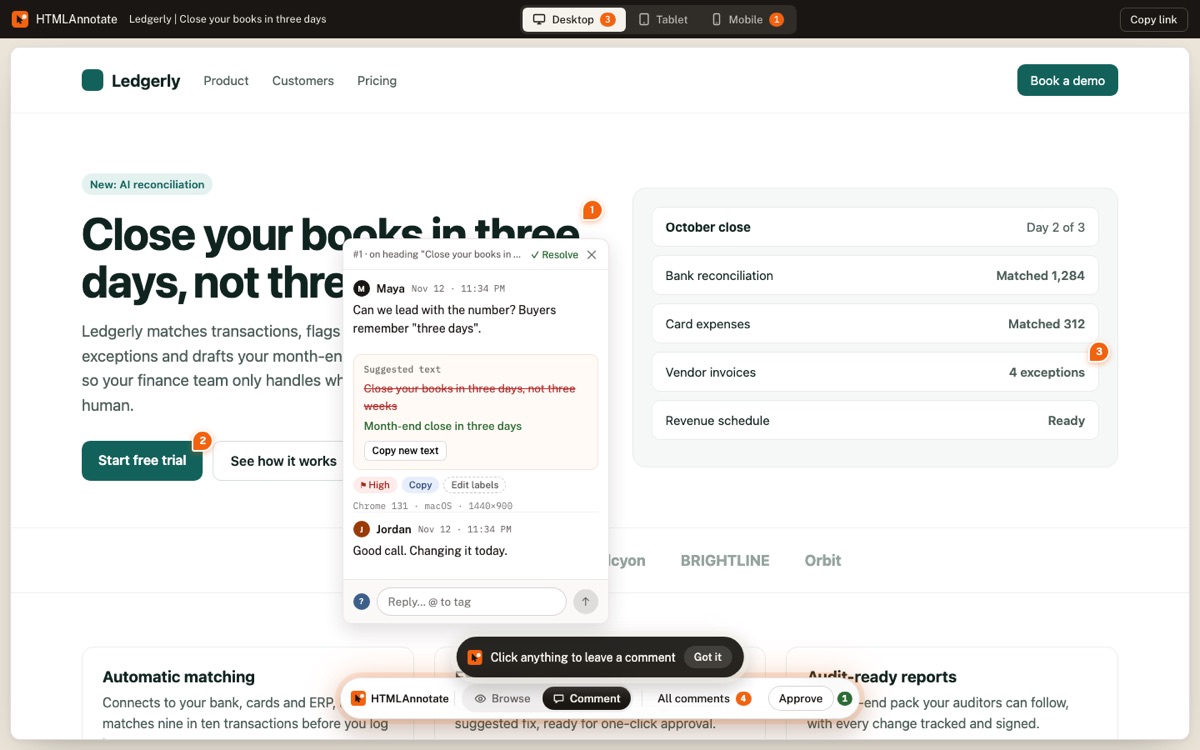
HTMLAnnotate opens the page itself, not a screenshot of it. Reviewers click the heading, image or button they mean and type. Each comment is pinned to that exact element and numbered on the page.
Pricing
This is the biggest difference. Markup.io's pricing page lists Pro at $79 a month for 50 MarkUps a month and Business at $499 a month for 200, with Enterprise on custom pricing. Every plan includes unlimited users, there is a 14-day free trial, and yearly billing saves two months. There is no free plan for creating reviews.
Markup.io
Pro: $79 a month for 50 MarkUps a month. Business: $499 a month for 200 MarkUps. Enterprise: custom. Unlimited users on every plan, 14-day free trial, no free plan.
HTMLAnnotate
- Free: 3 projects with unlimited pages, comments and reviewers; links last up to 14 days.
- Pro: $10 a month, or $8 a month billed yearly; you plus one teammate; links never expire.
- Team: $20 a month, or $16 a month billed yearly; up to 10 people; links never expire.

For a freelancer or small studio reviewing a handful of sites a month, HTMLAnnotate Free or Pro covers the same core workflow for a small share of the cost. For a large team reviewing many file types, Markup.io's unlimited users can make sense.
Features side by side
A quick view of what each tool covers, from public information checked on 14 November 2026. Sources are under the table.
| Feature | HTMLAnnotate | Markup.io |
|---|---|---|
| Free plan | Yes | No |
| Reviewers need an account | No | No |
| Code or extension on your site | No | No. Its Chrome extension is optional |
| Separate desktop, tablet and phone comments | Yes | Yes, desktop, tablet and mobile views |
| Live sites with scripts and animations | Yes | Yes, with Browse and Comment modes |
| Upload a single HTML file | Yes | No. HTML isn’t on its file type list |
| Suggested text edits | Yes | No sign of it in its docs |
| Approvals | Yes | Yes, a sign-off button on Pro and up |
| @mentions with email | Yes | Yes |
| Labels and priority | Yes | Low, medium and high priority; no labels |
| AI-ready brief of comments | Yes | No sign of it in its docs |
| CSV export | Yes | Yes, CSV or JSON, for workspace owners and admins |
| Integrations (Jira, Slack and similar) | Not yet | Slack and Teams built in; Jira, Asana and others through Zapier |
| PDF and image review | PDFs (not images) | Yes |
Sources: Markup.io’s own help docs, pricing and feature pages, its Chrome Web Store listing where it has one, and user reviews and forum threads, checked on 14 November 2026. “No sign of it” means we found nothing in its docs, pricing or reviews. Main pages used: chromewebstore.google.com, markup.io, educate.ceros.com, educate.ceros.com (2), educate.ceros.com (3), educate.ceros.com (4), markup.io (2), markup.io (3). Features change: check Markup.io’s site before you decide, and tell us if something here is out of date.
Where Markup.io is strong
- Reviews many file types in one place: websites, images, PDFs and video.
- Unlimited users on paid plans.
- A mature product with a long track record.
Where HTMLAnnotate is different
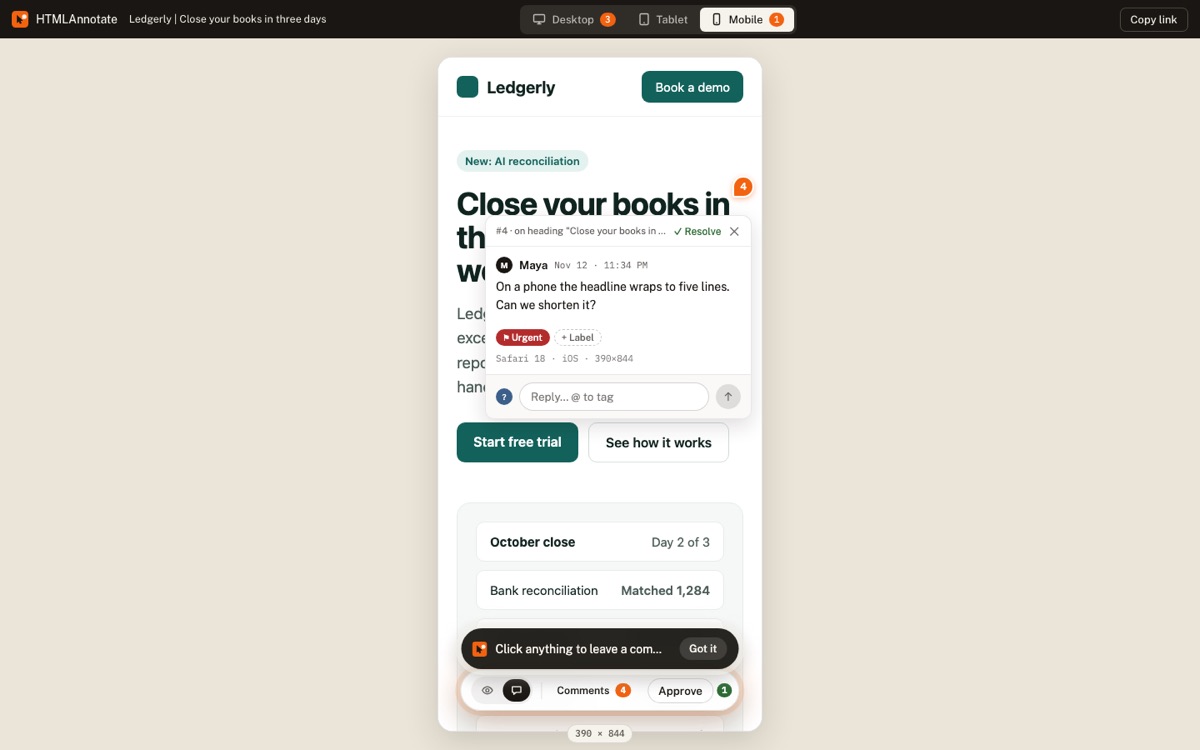
- Phone feedback stays on the phone. Every review link has Desktop, Tablet and Mobile views, and a comment left in one view only shows in that view. A note about the mobile menu never lands on the desktop layout.
- Live pages, not frozen copies. Imported sites run with their own scripts, so animations, sliders and menus work while people review.
- Made for AI-written pages. Upload the HTML file ChatGPT or Claude wrote, collect comments, then press Copy for AI to turn them into a brief the AI can act on.
- Small-team pricing. Pro is $8 a month billed yearly, with links that never expire. Reviewers are always free.
The reviewer experience
Markup.io lets guests comment through shared links without paying. Check their current guest settings for whether reviewers need to enter details.
On HTMLAnnotate, a reviewer opens the link, clicks anything on the page and types. The first time, they give a name and an email so you know who said what. After that they comment on every page you send. They can reply to threads, suggest exact new wording, tag teammates with @, and press Approve when the page is right.
Setup and workflow
With Markup.io
- Create a workspace and a new review.
- Add the website address or upload the file.
- Share the review with guests and collect comments.
With HTMLAnnotate
- Paste the page address (live or staging) or upload an HTML file at htmlannotate.com/new.
- Copy the review link and send it to your client or team.
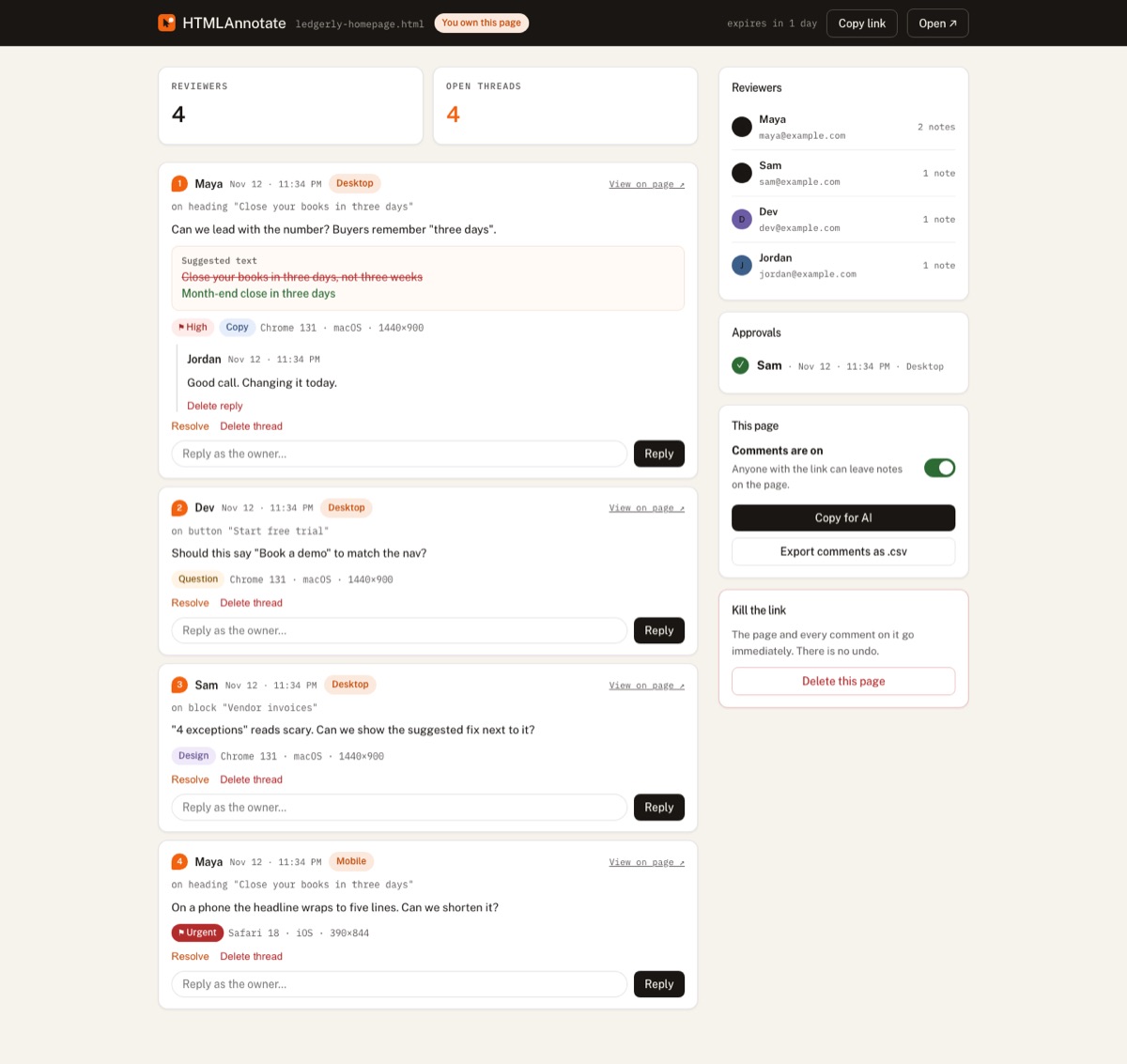
- Read every comment on the manage page, reply, resolve, and export or Copy for AI when you are ready to make changes.
Switching to HTMLAnnotate
Moving over takes minutes because there is nothing to migrate on your site. Keep Markup.io for image or video reviews if you need them, and use HTMLAnnotate for web pages and PDFs.
- Sign in at htmlannotate.com with Google or an email code.
- Paste the address of each page you are reviewing. There is nothing to install or remove from your site.
- Send the new review links. Reviewers need no account.
- If you work with a team, create a team on the Team page (Pro or Team plan) and share projects with it.
Questions
Is HTMLAnnotate a free alternative to Markup.io?
Yes. HTMLAnnotate is free for up to 3 projects with unlimited pages, comments and reviewers, with links that last up to 14 days. Paid plans with links that never expire start at $8 a month billed yearly.
Can HTMLAnnotate review PDFs or images?
PDFs, yes: upload a PDF and reviewers comment on any spot of any page. Standalone images and videos aren't supported, though reviewers can comment on any image inside a web page.
Do reviewers need an account on HTMLAnnotate?
No. They give a name and an email once, then comment on any page you send.
Does HTMLAnnotate work on staging sites?
Yes, as long as the staging address opens without a password or login.
Can I keep reviews forever?
Yes, on Pro and Team. Free links last up to 14 days.
Try it on a real page. Free, and your reviewers never need an account.
Import a page